

Your home is your biggest asset. How do you use it without regret?
Plenty of retirees in Edmonton, St. Albert, Sherwood Park, Spruce Grove, Leduc, Beaumont and Fort Saskatchewan have a lot of equity in their homes and a fixed income that doesn’t stretch as far as it used to. When you need cash for renovations, helping family, paying off debt or just breathing room, two options usually come up: a reverse mortgage and a home equity line of credit (HELOC).
They both draw on the same equity, but they work in almost opposite ways. The timing matters too: after the Bank of Canada’s October 28 increase, borrowing costs are higher, and that pinches hardest on a fixed retirement income.
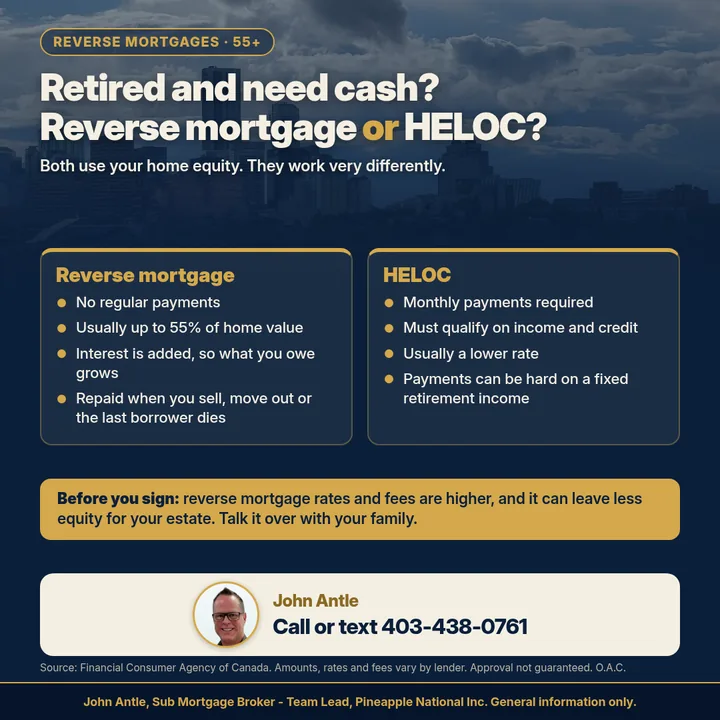
Side by side
Reverse mortgage (55+)
- No regular payments. You don’t make monthly mortgage payments.
- Usually up to 55% of your home’s value, for homeowners 55 and older.
- The balance grows. Interest is added to what you owe instead of being paid each month.
- Repaid later: when you sell, move out, or the last borrower dies.
- Costs more. Rates are higher than a regular mortgage or a HELOC, and there are fees.
HELOC
- Usually a lower rate than a reverse mortgage.
- You have to qualify on your income and credit, which can be harder once you’ve retired.
- Monthly payments are required from the start.
- Payments can change. When borrowing costs rise, as they did after the October 28 increase, what you pay can rise too.
- Can be tight on a fixed income. A payment that looks fine today has to fit your budget for years.
The trade-offs, honestly
Neither option is “free money.” Each one solves a problem and creates a different one.
- A reverse mortgage trades payments for equity. Skipping monthly payments can protect your cash flow, but because interest keeps being added, what you owe goes up year after year, and there’s usually less left in the home for your estate.
- A reverse mortgage costs more to carry. Its rates and fees are higher than a regular mortgage or a HELOC, so it’s worth being sure the flexibility is worth the price.
- A HELOC trades a lower cost for a monthly commitment. You keep more of your equity if you pay it down, but you have to qualify on income and credit, keep up the payments, and live with a rate that can change.
Before you sign: reverse mortgage rates and fees are higher, and it can leave less equity for your estate. Talk it over with your family, and ask any questions you have, before you commit to either option.
Questions worth asking yourself first
Can I comfortably make a monthly payment?
If yes, and you can qualify on your income and credit, a HELOC is often the lower-cost route. If a payment would strain your budget, that’s where a reverse mortgage’s no-payment feature comes in.
How long do I plan to stay in the home?
A reverse mortgage is repaid when you sell, move out, or the last borrower dies, so the longer it runs, the more the balance grows.
How much does leaving equity to my family matter?
If passing on as much of the home as possible is a priority, factor in that a reverse mortgage usually leaves less equity for your estate.
Have I talked it over with my family?
It’s your decision, but it touches the people you’ll leave the home to. A shared conversation now avoids surprises later. I’m happy to walk you and your family through both options.
Depending on your situation, a refinance may also be worth comparing. You can see everything I help with on the mortgage services page.
Fully online, anywhere in the Edmonton area
Whether you’re in Edmonton, St. Albert, Sherwood Park, Spruce Grove, Leduc, Beaumont, Fort Saskatchewan or elsewhere in the region, we can do all of it from your kitchen table: video meetings, phone calls, e-signing and secure document upload. Adult children or other family members can join the same call from wherever they live. See how an online mortgage works and the communities I serve.
John Antle, Sub Mortgage Broker - Team Lead, Pineapple National Inc.
General information only, not personalized financial or mortgage advice. Speak with a licensed mortgage professional about your situation. Amounts, rates and fees vary by lender. Approval not guaranteed. O.A.C.
Sources: Financial Consumer Agency of Canada, “Reverse mortgages” (opens in a new tab); Pineapple, “Reverse Mortgage vs. HELOC vs. Unsecured Loan” (opens in a new tab); Pineapple, “What is a Reverse Mortgage?” (opens in a new tab).